
Last Updated on 5 months ago by Jayne Raven
 You are probably reading this on a screen right now. There is a reasonable chance your chin is slightly forward, your shoulders are rounded and your lower back is not particularly well supported. You are not unusual: according to recent figures, forward head posture affects close to 83% of regular desk workers and over 80% of remote workers report some form of musculoskeletal discomfort linked to their work setup.
The shift to hybrid and home working that accelerated during 2020 has continued to reshape how and where we work. In Brighton and across the UK, many adults now spend a significant portion of their day working from kitchen tables, spare bedrooms, and sofas, often with equipment that was never designed for extended use.
The physical cost of this is becoming increasingly clear. Neck pain, upper back tension, headaches, lower back ache and fatigue are among the most common complaints we hear at Sundial Clinics and in many cases, they trace back to posture, workstation setup and the simple habits we have built around our screens.
The good news is that most of this is addressable. This guide covers the key posture principles that ergonomics and MSK research actually support in 2026, the practical changes you can make to your setup and daily habits, and the signals that suggest it would be worth getting a professional to take a look.
What Is the 90-90-90 Rule and Does It Still Hold Up?
The 90-90-90 rule is the traditional foundation of ergonomic desk setup. It refers to maintaining three 90-degree angles simultaneously: hips at 90 degrees (thighs roughly parallel to the floor), knees at 90 degrees (feet flat on the floor or a footrest) and elbows at 90 degrees (forearms level with the desk, wrists in a neutral position).
It remains a reasonable starting framework, particularly for people using a properly adjusted desk chair and monitor. However, more recent ergonomics research has introduced some important nuances.
Why Static “Perfect Posture” Is Not the Whole Answer
One of the most important shifts in ergonomics thinking over the past decade is the move away from the idea that there is one ideal posture to achieve and hold. A widely cited principle, supported by research from the field of occupational health, is that the best posture is your next posture, meaning that movement and variation are more protective than any fixed position, however technically correct.
A 2012 Cochrane review by Verhagen et al. confirmed that neither ergonomic adjustments alone nor exercise alone are consistently sufficient to prevent work-related neck and upper limb disorders. The combination of both, alongside behavioural change, produces the best outcomes. This is important context: it means that buying the right chair is not the full answer. How often you move matters as much as how you are positioned when you sit.
The Sit-Stand Ratio: What the Evidence Recommends
The sit-stand ratio has become one of the most discussed aspects of workplace ergonomics in recent years, partly driven by the marketing of standing desks and partly by growing evidence linking prolonged sitting to musculoskeletal and cardiovascular risk.
Current guidance from researchers including Buckley et al. (2015), published in the British Journal of Sports Medicine, recommends that office workers aim to accumulate a minimum of two hours of standing and light activity per day, with a progression towards four hours. This should be broken up rather than accumulated in one block. The research suggests that brief, frequent transitions between sitting and standing (every 30–45 minutes) are more beneficial than long periods of either.
Practically speaking, if you do not have access to a standing desk, this principle can be applied through regular movement breaks: standing during phone calls, walking to make a drink every 45 minutes or using a small timer to prompt positional changes throughout the day.
A simple rule of thumb: Aim to change position at least once every 30 minutes. You do not need a standing desk to do this: you just need a habit.
Understanding Tech Neck: What It Is, What It Does and Why It Matters
“Tech neck” is the colloquial term for a posture pattern that has become extraordinarily common: the forward displacement of the head relative to the shoulders, caused by prolonged downward or forward gaze at screens, phones and laptops.
In clinical terms, this is often referred to as forward head posture (FHP), and it has measurable physical consequences. Research by Hansraj (2014) demonstrated that for every inch (approximately 2.5cm) the head moves forward of its neutral position over the spine, the effective load on the cervical spine approximately doubles so a head that weighs around 5kg in neutral position creates an effective load of 12kg at 5cm of forward displacement, rising to over 20kg at 7.5cm.
This load is borne by the muscles, tendons, and discs of the neck and over months and years of habitual forward head posture, it can contribute to muscle fatigue, joint irritation, altered movement patterns and pain.
What Does Tech Neck Feel Like?
The most common presentations include:
- A persistent ache or stiffness at the base of the skull and upper neck
- Tension across the tops of the shoulders and upper trapezius muscles
- Headaches that begin at the back of the head and may travel forward (these are known as cervicogenic headaches, originating from the neck structures)
- A feeling of tightness or difficulty turning the head fully
- In some cases, tingling or numbness in the arms or hands, which warrants prompt professional assessment
Tech Neck, Breathing and Brain Fog
One aspect of forward head posture that often surprises people is its relationship to breathing. Slouching, whether at a desk or on a sofa, compresses the thoracic cage and reduces the mechanical efficiency of the diaphragm. This can lead to shallower breathing patterns, reduced lung capacity and increased reliance on the accessory muscles of the neck for breathing.
The downstream effects of this include increased fatigue, reduced ability to concentrate and a tendency towards a low-level tension state. This may partly explain why many remote workers report cognitive fatigue and difficulty focusing during long working days. It is not only a screen time issue; it has a mechanical component too.
Setting Up Your Workspace: A Practical 2026 Guide
The following guidance is based on established ergonomics principles and is designed to be realistic for home workers who may not have access to high-end office equipment. Small, affordable changes often make a meaningful difference.
Screen and Monitor Position
Eye level: the top of your screen should be at roughly eye level, so that your gaze falls naturally to the upper third of the screen. Looking down at a laptop flat on a desk forces forward head posture even in people who are conscious of their positioning.
Distance: approximately arm’s length (50–70cm) from your eyes for a desktop monitor. Closer than this strains the eyes and encourages forward lean.
Laptop use: a laptop riser or stack of books combined with a separate keyboard and mouse is one of the most cost-effective ergonomic changes you can make. It costs very little and immediately improves the ability to maintain a neutral head and neck position. (At Sundial Clinics, we sell an adjustable frame suitable for an iPad, Kindle or other small screen.)
Chair and Seating Position
Seat height: adjust so that your feet rest comfortably flat on the floor (or a footrest) and your hips are at approximately 90 degrees. Avoid sitting with your feet dangling or your knees higher than your hips.
Lumbar support: a small rolled towel or lumbar cushion placed at the curve of the lower back can significantly reduce lumbar loading during prolonged sitting. Research by O’Sullivan et al. (2012) supports individualised lumbar support as part of a broader approach to low back pain management.
Sitting forward or back: there is no single correct answer. Some people do better with an upright, active sitting posture; others benefit from a more reclined position (approximately 100–110 degrees) which reduces lumbar disc pressure. Varying between the two is, again, preferable to holding either position rigidly.
Keyboard, Mouse, and Wrist Position
Keep the keyboard close enough that your elbows remain at roughly 90 degrees and your wrists are in a neutral, relaxed position, not bent upward or downward.
A mouse positioned too far to the side causes shoulder abduction and upper trapezius loading; keep it close and inline with your shoulder.
If you experience wrist or forearm discomfort, a wrist rest can help during periods of inactivity but should not be used while actively typing, as this restricts natural wrist movement.
Lighting and Screen Glare
Poor lighting that causes you to lean towards the screen or tilt your head to reduce glare is a common and overlooked contributor to neck tension. Position your monitor so that windows are to the side rather than directly in front or behind and use a matte screen filter or adjust blinds to reduce glare.
Movement Habits — The Changes That Matter More Than Your Chair
Even the most ergonomically perfect workstation cannot compensate for sitting still for six hours. Movement is protective and it does not need to be complicated or time-consuming.
The 30/30 Principle
Set a timer or use a desk reminder app to prompt a positional change or brief movement break every 30 minutes. This does not need to be exercise: standing up, walking to the kitchen or doing a short stretch is sufficient. The evidence supports frequent, brief interruptions to sitting as more beneficial than longer, less frequent breaks.
A Simple Daily Desk Stretch Routine (5–7 Minutes)
The following routine can be performed at your desk and targets the areas most commonly affected by desk-based work. It draws on movement principles supported by physiotherapy and occupational health research. We have an exercise sheet here for you to print too.
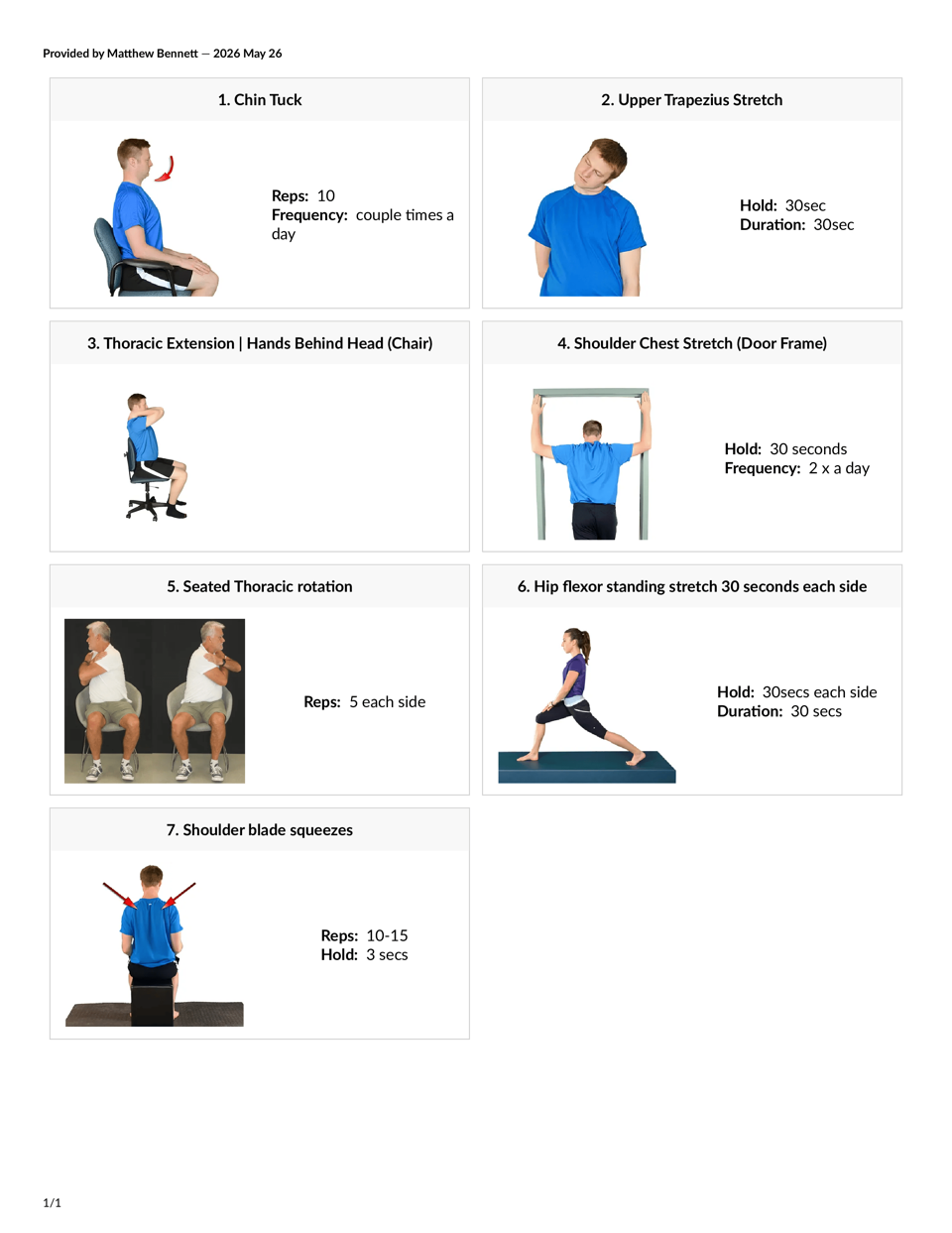
1. Chin tucks (cervical retraction) 10 repetitions Sit tall. Gently draw your chin straight back, as if making a “double chin.” Hold for 3–5 seconds, release. This counteracts forward head posture by activating the deep cervical flexors. Research by Falla et al. (2004) demonstrated that training the deep cervical flexors reduces neck pain and improves postural control in people with chronic neck complaints.
2. Upper trapezius stretch 30 seconds each side. Sit tall, place one hand flat on the seat of the chair to anchor your shoulder down, and gently tilt your ear toward the opposite shoulder until you feel a stretch in the side of the neck. Do not force or over-stretch. Breathe gently into the stretch.
3. Thoracic extension over chair back 5–8 repetitions Shuffle to the edge of your seat. Lace your fingers behind your head. Gently extend backwards over the top of your chair back, opening the chest and upper back. Move slowly and only within a comfortable range. This addresses the thoracic rounding that is endemic in desk workers.
4. Doorway chest stretch 30 seconds Stand in a doorway with arms at 90 degrees, forearms resting on the door frame. Step forward gently until you feel a stretch across the chest and front of the shoulders. This opens the pectorals, which become shortened with prolonged rounded shoulder posture.
5. Seated spinal rotation 5 repetitions each side Sit tall, cross your arms over your chest, and rotate gently to each side, moving only within a comfortable range. Do not force rotation. This mobilises the thoracic spine and counters the stiffness that accumulates from sustained sitting.
6. Hip flexor standing stretch 30 seconds each side Stand and take a lunge position. Keep your torso upright and gently push your hips forward until you feel a stretch in the front of the hip of the rear leg. Prolonged sitting shortens the hip flexors and contributes to the anterior pelvic tilt that flattens the lumbar curve and contributes to lower back discomfort.
7. Shoulder blade squeezes 10–15 repetitions Sit tall. Draw your shoulder blades together and down, as if trying to put them in your back pockets. Hold for 3 seconds, release. This activates the lower and middle trapezius, which are commonly inhibited in people with rounded shoulder posture and upper trapezius dominance.
How Bad Can Poor Posture Get? Understanding the Bigger Picture
Most posture-related discomfort does not represent serious pathology and it is important to say that clearly. The vast majority of people who present with tech neck, desk-related back pain or postural headaches have a functional, reversible problem and respond well to the combination of postural education, targeted exercise and in many cases, a short course of hands-on care.
However, poor posture that is sustained over long periods without intervention can contribute to a range of issues.
- Chronic neck and upper back pain that becomes increasingly difficult to manage
- Cervicogenic headaches that occur several times per week
- Secondary shoulder problems, as altered scapular movement patterns develop
- Increased risk of disc-related symptoms in the cervical spine
- Fatigue, reduced concentration and a general sense of physical tension that affects quality of life
None of this is intended to alarm. It is offered as context for why addressing posture sooner rather than later makes practical sense.
The Anxiety Side of Postural Pain
It is worth acknowledging that physical discomfort, particularly when it involves the head and neck, frequently generates worry. Headaches associated with neck pain are sometimes mistaken for something more serious and the uncertainty of not knowing what is causing the pain can itself increase muscle tension and amplify discomfort.
Research by Linton and Shaw (2011) in Spine identified catastrophising and anxiety about pain as significant predictors of the transition from acute to chronic pain. This is not to suggest the pain is “in your head” (it is very much physical) but it does mean that getting a clear, reliable explanation of what is happening can itself be therapeutic. Many of our patients tell us that understanding the cause of their pain was the most reassuring part of their first appointment.
Signs That It Would Be Worth Getting a Professional to Look at This
Self-help is valuable and for many people the changes described above will be sufficient. But there are clear signals that a professional assessment would be sensible:
Consider booking an assessment if you notice these signs.
- Your neck or back pain has been present for more than two to three weeks without meaningful improvement
- You are getting recurring headaches that you associate with neck tension or position
- The pain is disrupting your sleep or your ability to concentrate at work
- You notice your pain is getting gradually worse rather than staying the same
- You have tried adjusting your workstation and doing exercises, but the discomfort persists
- You are unsure whether your setup or habits are the cause and would like clarity
- You simply want a professional to assess your posture and movement and give you a personalised plan
A posture and movement assessment at Sundial Clinics typically involves a thorough discussion of your symptoms, history and lifestyle, followed by a physical assessment of how you move, where your posture patterns lie and what is likely driving your discomfort. You will leave with a clear explanation of what was found and a practical plan for what to do about it.
Most people with desk-related postural pain begin to notice meaningful improvement within four to eight sessions, particularly when combining hands-on care with a home exercise programme.
Have a question before you decide to book? Just give us a call or send us a message: we are always happy to help you work out whether an appointment would be useful.
Red Flags — When to Contact Your GP or Seek Urgent Help
The following symptoms can occasionally accompany neck or back pain but may indicate something that needs medical rather than MSK assessment. They are uncommon, but important to know:
See your GP promptly if you have neck or back pain alongside these symptoms.
- Unexplained weight loss
- Persistent night pain that wakes you from sleep regardless of position
- Significant weakness, numbness or tingling that extends down one or both arms (particularly if progressive)
- Pain that is not relieved at all by rest or changes in position and is constant in nature
- Fever or generally feeling unwell alongside the spinal pain
- A history of cancer, osteoporosis or long-term steroid use with new onset of spinal pain
Go to A&E immediately if you experience:
- Sudden severe weakness in both legs
- Loss of bladder or bowel control (these are symptoms of cauda equina syndrome, a rare but serious spinal emergency)
- A sudden, thunderclap headache that comes on in seconds and is unlike any headache you have experienced before
These presentations are uncommon in the context of postural pain, but it is important to name them clearly so you have the information you need.
How Sundial Clinics Can Help
At Sundial Clinics in Brighton, we see a significant number of patients whose pain can be traced, at least in part, to how they work and how they use their bodies across the day. This is not a niche concern: it is one of the most common MSK presentations in adults of working age and it has become more prominent as hybrid and home working has become the norm.
Our team includes chiropractors, physiotherapists and massage therapists who take a genuinely collaborative approach to postural and work-related pain. What that looks like in practice:
- Assessment: a thorough examination of your posture, movement, and the areas of discomfort with a clear explanation of what we find, in plain language.
- Hands-on care: depending on what is found, this might include spinal manipulation or mobilisation (chiropractic), manual therapy techniques (physiotherapy) or soft tissue work and massage therapy, often in combination.
- Exercise guidance: we will send you a specific home exercise programme, tailored to your assessment findings, designed for your pattern.
- Workstation advice: we will offer practical guidance on your setup, based on your individual posture findings and work situation.
- Referral when needed: if we find something that would be better assessed by a GP or specialist, we will tell you clearly and help you understand what to do next.
Most people with postural pain associated with desk work do not need lengthy treatment. A short course of care, typically four to eight sessions, alongside consistent application of the self-help strategies in this article, tends to produce meaningful, lasting improvement.
Frequently Asked Questions
Q: What exactly is tech neck and do I have it? Tech neck (forward head posture) describes the habit of holding the head forward of the shoulders during screen use. If you regularly use a laptop, phone or tablet and notice stiffness or aching in the upper neck and base of skull, there is a good chance your head position is contributing. A professional assessment can confirm this and identify exactly what is driving your discomfort.
Q: Can poor posture cause headaches? Yes. Cervicogenic headaches (headaches originating from the neck structures) are a recognised and common presentation. They typically begin at the base of the skull and may travel to the forehead or behind the eyes. They are often associated with neck stiffness and made worse by sustained sitting. They are not dangerous and respond well to physiotherapy and chiropractic care when properly identified.
Q: I have a standing desk. Does that mean I do not need to worry about posture? A standing desk is a useful tool, but it does not automatically solve posture problems. Standing with poor alignment (hips swayed, weight unevenly distributed, screen at the wrong height) creates its own set of issues. The evidence supports variation between sitting and standing, not prolonged standing as a replacement for prolonged sitting.
Q: How long until my posture improves with exercises? This depends on how long the patterns have been present and how consistently you apply the exercises and positional changes. Most people notice some improvement within two to four weeks of consistent effort. Deeper postural habits take longer to shift (typically eight to twelve weeks) but progress is usually noticeable well before that.
Q: Is this something a physio or a chiropractor handles? Which one should I see? Both physiotherapists and chiropractors at Sundial Clinics are well-placed to assess and treat posture-related neck and back pain. Physiotherapy tends to place particular emphasis on exercise rehabilitation and movement education; chiropractic typically combines manual therapy like spinal manipulation alongside exercise and lifestyle guidance. There is significant overlap in practice. If you are unsure which to book, simply call us and we will help you choose the most appropriate starting point.
Q: My back aches every day but I manage it. Is it worth bothering to get it assessed? We would gently push back on the idea of managing daily pain as the baseline. Daily pain that you have adapted to is still pain, and it is often easier to address than people expect, particularly when it is posture and work-habit related. An assessment may well reveal straightforward, addressable causes. It is worth a conversation.
Q: Can massage therapy help with postural pain? Yes, and it is often a valuable part of a broader approach. Massage therapy can reduce muscle tension, improve circulation to chronically loaded soft tissue and support the relaxation of areas that have become habitually tight. At Sundial Clinics, massage therapists often work alongside our chiropractors and physiotherapists for patients with persistent postural tension.
References (peer-reviewed)
1. Hansraj, K.K. (2014)
Assessment of stresses in the cervical spine caused by posture and position of the head.
2. Buckley, J.P. et al. (2015)
The sedentary office: a growing case for change towards better health and productivity.
3. Verhagen, A.P. et al. (2012)
Conservative interventions for preventing work-related musculoskeletal disorders.
4. Falla, D. et al. (2004)
An electromyographic analysis of the deep cervical flexor muscles in performance of cranio-cervical flexion.
5. O’Sullivan, P. et al. (2012)
Individualised cognitive functional therapy compared with a combined exercise and pain education class for patients with non-specific chronic low back pain.
6. Linton, S.J. & Shaw, W.S. (2011)
Impact of psychological factors in the experience of pain.
7. Gupta, N. et al. (2015)
Is objectively measured sitting time associated with low back pain? A cross-sectional investigation in the NOMAD study.
8. Nejati, P. et al. (2015)
The relationship of forward head posture and rounded shoulders with neck pain in Iranian office workers.
About Matthew Bennett, Chiropractor Brighton
Matthew Bennett is the founder and principal chiropractor at Sundial Clinics Brighton, established in 1991. With over 35 years of clinical experience, Matthew qualified from the Anglo-European College of Chiropractic in 1987 and served as President of the British Chiropractic Association for four years. As a Fellow of the Royal College of Chiropractors and former team chiropractor for Brighton and Hove Albion FC and the British Alpine Ski Team, Matthew combines evidence-based chiropractic treatment with sports performance expertise. His authority in musculoskeletal health has been recognised through national media appearances, expert witness roles and contributions to professional publications. Matthew’s commitment to clinical excellence ensures patients receive the most effective chiropractic care in Brighton.